Back
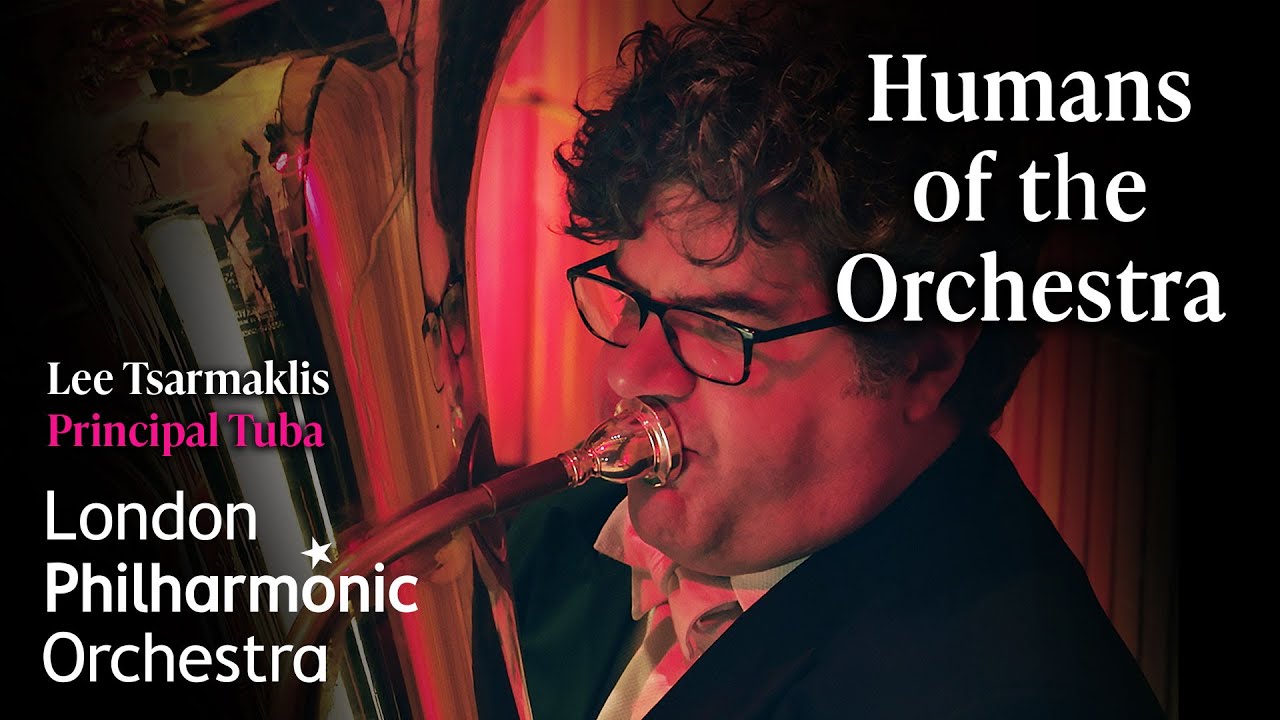
Humans of the Orchestra – Principal Tuba: Lee Tsarmaklis
Wed 7 Oct, 2026
Meet Lee Tsarmaklis, Principal Tuba of the London Philharmonic Orchestra. In our Humans of the Orchestra series, we get to know the people behind the music. Here, Lee Tsarmaklis, Principal Tuba of the London Philharmonic Orchestra, reflects on the path from a school band in Buckinghamshire to the LPO, what it takes to anchor the brass section, and the concerts and projects that have stayed with him.
What does it mean to be Principal Tuba?
So the Principal Tuba has several roles. One is to sort of underpin, be a bassline of the brass section. You have a solo role every now and again, a few bars here and there, which gets the heart rate going a bit. You have to be part of the double basses and where you pitch that depending on repertoire, composer, conductor is what you have to try and do as well as you can. For the last 34 years I’ve been playing professionally, I’ve been just one [single Tuba in the Orchestra], and you get used to that. That has its challenges. When it’s going well, it’s fine. When it’s not, it’s on you. There’s no one else.
How did you end up playing the tuba?
So, I grew up in Athens until I was 12 and then my parents emigrated to the UK, to a small village called Bourne End in Buckinghamshire. I took up the tuba pretty much on the first day of secondary school. We had a brilliant music teacher who made sure that every new kid had the opportunity to learn an instrument. It wasn’t school curriculum or anything, he just did it because he was extremely keen to have a band. He said, ‘You can play the most important instrument in the band.’ It’s only when I took up the tuba I realised that there wasn’t a tuba player in the band, I was the only one. And he really was desperate for somebody probably big enough or stupid enough to take it up.
So I pretty much played the tuba every night after school in some band or another. When I was a member of the Bucks Youth Orchestra, they wanted me to play the Vaughan Williams Tuba Concerto. So they offered me lessons from a tuba player, and that was my first ever tuba lesson. Up until then I’d been learning with a cornet player, Mr. Steventon, who was my peripatetic teacher at school. And this chap came along called Paul Smith and he gave me a couple of lessons. As soon as I heard how he sounded, it was probably a life-changing moment. I thought: ‘I really, really want to sound like that and play like that’.
I then auditioned for the Royal Academy of Music. I had three wonderful years there learning under Patrick Harrild. He was like a musical father to me really, and still is after all these years. I did three years at the Royal Academy and I was very fortunate to be offered a job in the Hong Kong Philharmonic at the end of my third year. So I went to the Hong Kong Philharmonic for six years. And I left there after the handover [of Hong Kong from the UK to China in 1997] and then I joined the Royal Philharmonic Orchestra and I was there until I joined the LPO in 2000.
Which performances have meant the most to you?
I think the LPO has a unique spirit and a unique sound and I don’t think that’s changed at all through different conductors, Principal Conductors or personnel. I think that sound has remained. I think probably what stands out as a project was recording The Lord of the Rings. That was very special. Also recording the national anthems for the London Olympics, all 250-odd of them over a week. That was also a moment which I thought was quite special. Quite a few concerts. I don’t even know where to start. I’ll probably pick one with each Principal Conductor. I’ll pick a Bruckner 7 at Carnegie Hall with Kurt Masur. With Vladimir Jurowski, there’s so many, but the Ring Cycle is probably up there. And with Ed, I would say Mahler 2. That was a very special occasion.
Being part of the brass section, we work hard and we play hard. I love just being a part of this team, this amazing team. I love that.
Hear it from Lee himself