

 Back
Back
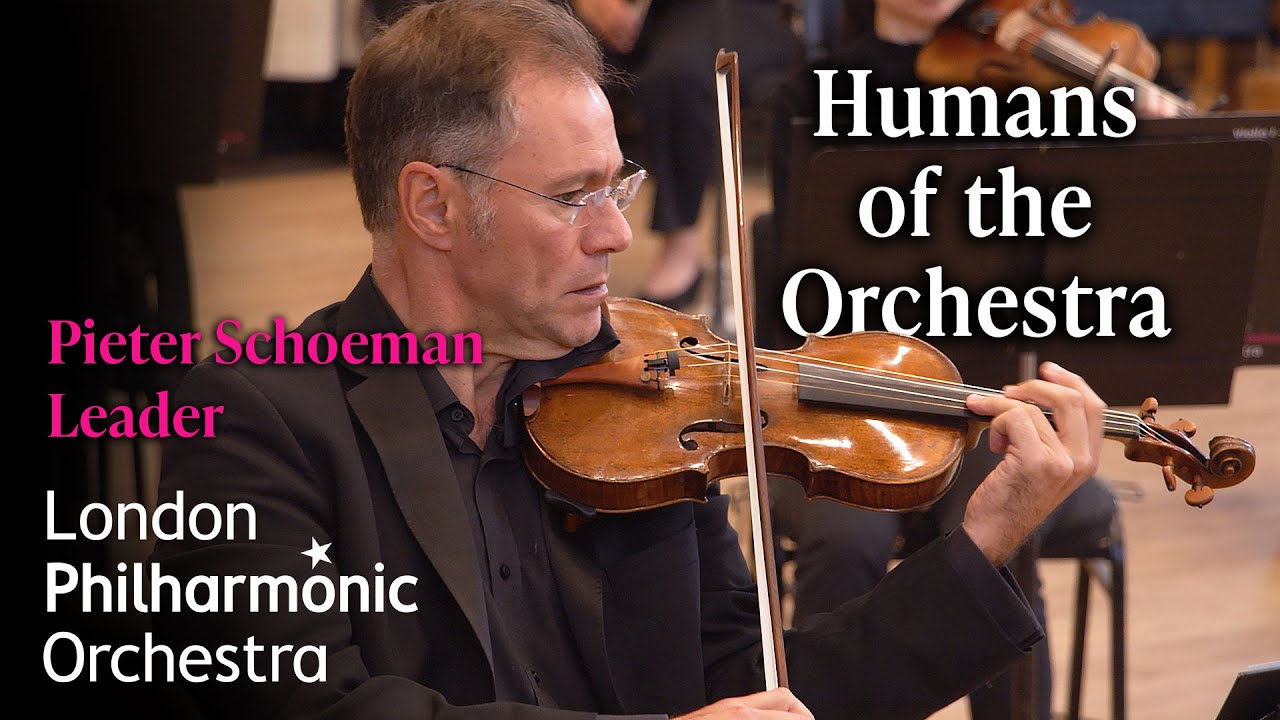
Humans of the Orchestra – Leader: Pieter Schoeman
Mon 13 Jul, 2026
Meet Pieter Schoeman, Leader of the London Philharmonic Orchestra. In our Humans of the Orchestra series, we get to know the people behind the music. Here, Pieter reflects on his journey to the LPO, what it means to lead an orchestra, and the moments that continue to inspire him.
What’s it like being the leader of the LPO?
First of all, you’ve got to play those violin solos and you have to sound like a soloist. In the last four months, I’ve got to play Ein Heldenleben, Tchaikovsky Swan Lake, Strauss Metamorphosen, Beethoven Missa Solemnis. The solos keep on coming, and you’ve got to be able to handle that.
I’m the Principal of the First Violin section and so I have the largest section in the orchestra. My duty towards my section, like every other Principal’s duty, would be to take care of their section during rehearsals, making sure everybody’s happy and comfortable, making sure the conductor is happy. But then when it comes to the actual playing, it’s how to make a large group of individuals play together and to feel music the same way.
A conductor’s beat can be interpreted in different ways. We practise with metronomes at home as it’s very important but essentially, nothing is metronomical. So, a lot of musicians find it easier, sometimes more natural, to follow the bow of the Leader. They can anticipate when I’m about to change bow or when I’m about to just change my finger. Nothing is constant. And that’s also the wonderful thing about live music, is that you can rehearse and rehearse and rehearse, you get to the concert and it’s going to be different. And as the Leader, I have to be ready for these differences.
So it’s a very vast subject really. And that’s why I say I’m still trying to figure it out, because I’ve been at it for really over 20 years — because officially I’ve been Leader of this orchestra for I think almost 17 years, but it’s actually been almost 23 years now that that I’ve been leading most of the LPO’s concerts.
How did your musical journey lead you to the LPO?
I grew up in South Africa and started playing the violin when I was four and a half years old. When I was 11, the very famous violin teacher Dorothy DeLay of Juilliard came to give master classes in South Africa, and I was one of the ones chosen to play for her. At that event, Jack de Wet, who I still consider was South Africa’s best violin teacher, was watching and afterwards he came to my parents and he offered to teach me for free. For five years I took the plane every month for my violin lessons, and I would usually stay with him and his wife.
When I was 15, I won a scholarship to go to the Interlochen National Music Camp in Michigan. There were over 25 different countries represented. I entered the concerto competition with the Bartók Second Violin Concerto and I won, and I got to solo with the World Youth Symphony Orchestra, which was for me a huge turning point, because from then on I knew there was nothing else in life that I would want to do — that was my moment. So 1984 will always stick in my mind.
So I went to University of Southern California in Los Angeles for four years. My next really amazing thing happened — that I met my childhood hero Pinchas Zukerman in a masterclass, and we really hit it off, and after a year he introduced me to my next teacher, Sylvia Rosenberg, a formidable, incredible teacher in New York. So I moved to New York to study with her.
But after eight years of studies in America, my family thought it’s time for me to get a job, because I’m the kind of guy who could study just forever — I’m just like the eternal student. But somewhere we got to draw the line. Eight years of American studies is a very expensive business, and I’ve been very lucky to have had sponsorship throughout all those years.
My fiancée at the time already had a job in the Monte Carlo Philharmonic Orchestra. Now I’m looking at ways to move over to that part of the world. The only position that opened up was in the Nice Philharmonic Orchestra, right next door. So I prepared for the audition and I gave my fiancée’s phone number in France as my contact number.
I got so lucky there as there was an administration oversight: they didn’t spot that I’m not from the European Union, I still had a South African passport. So they called my fiancée. They said, “No, no, no, no. Impossible. Mr. Schoeman cannot audition for us. He’s the only one not from the European Union there.” So she said, “Look, you can’t do this. He’s on a plane right now over from America already to come do the audition.” So they said, “Okay, we’ll make an exception,” thinking I will probably disappear between the rounds.
The audition was behind the screen, so they had no idea who was playing, and I went from one round to the next to the next. There were two people in the finals, and then finally when they chose the winner and they took the screen away — there I’m standing. A big problem for them. So they told me, “We’ll give you three months — if you can get the work permit, then the job is yours. If not, we give it to the runner up.” So I applied for the work permit, went back to Sylvia Rosenberg to continue studying while I wait, and then about two months later I got notified that I have the work permit. I started my work in Nice, and then the LPO was my second job, several years later.
What’s your favourite part of being in the LPO?
Well, I think the one thing about the London Philharmonic Orchestra, what makes it unique, is its flexibility, and how to adapt, how to listen. And I think a lot of that has to do with the fact that four months of the year we play in Glyndebourne. We sit in the pit, we accompany the opera singers — it’s a completely different ball game. It’s much more unpredictable. You don’t always hear the singers very well and so it makes you so aware and so flexible.
And then also what I love about my colleagues — how we all get up at 4:30 in the morning, go out to Heathrow, get on the first flight over to some European city. You arrive there, you eventually go to the hall, have a rehearsal, and you play the concert that first night, and everybody is knackered. And when it comes time for the concert, everyone steps up to the game and can do some of the most amazing playing. I’m always shocked at how awful we all feel beforehand and how well we can play at that moment.
I have incredible respect for my colleagues, and also British orchestras are famous for being really team players and knowing how to play together. In the string section there are many international players, and we’ve all learned to enter this wonderful British tradition of being a good team player and how to play together.
What I love probably most is being in the centre of the sound, it’s an incredible experience. Just to be among so many gifted musicians, to be on the same stage, is amazing.
I’m the luckiest person in this orchestra, and I would not trade it for anything else.
Hear it from Pieter himself