

 Back
Back
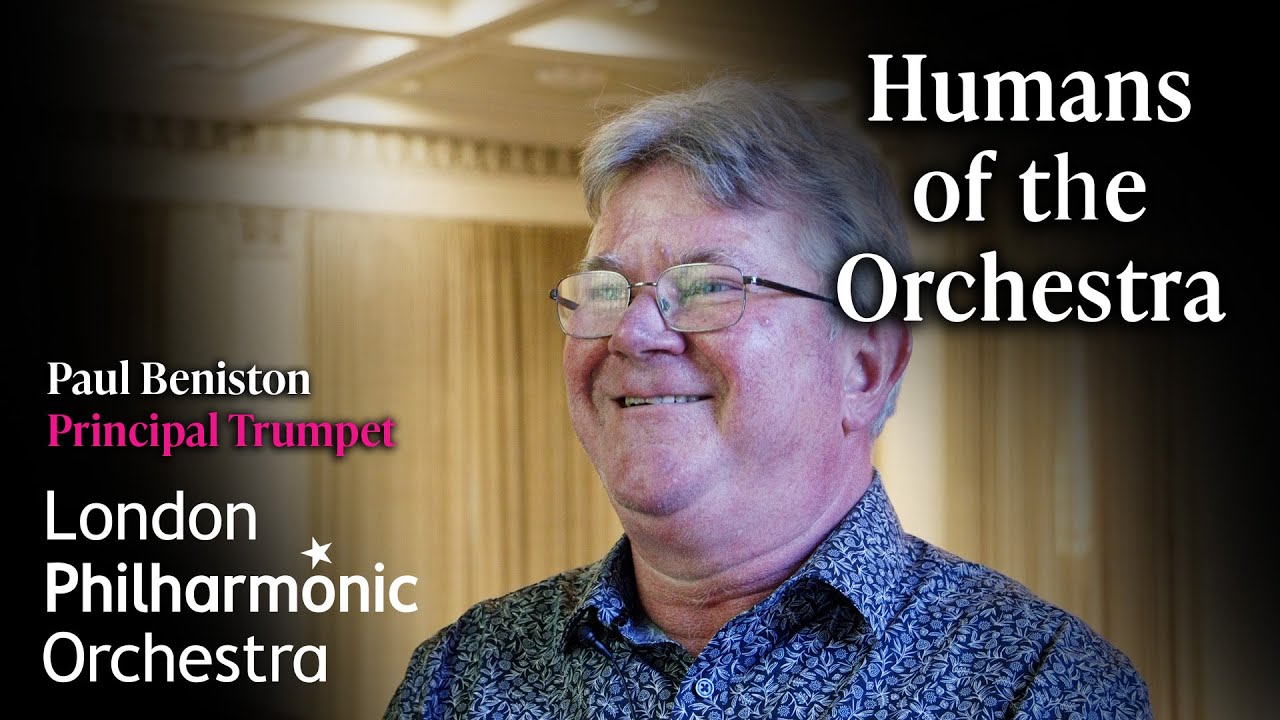
Humans of the Orchestra – Principal Trumpet: Paul Beniston
Tue 18 Aug, 2026
Meet Paul Beniston, Principal Trumpet of the London Philharmonic Orchestra. In our Humans of the Orchestra series, we get to know the people behind the music. Here, Paul Beniston shares his journey from discovering the trumpet in a Salvation Army family to becoming Principal Trumpet of the London Philharmonic Orchestra, the traditions of the brass section, and what it takes to perform some of the most exposed trumpet passages in the orchestral repertoire.
How did you discover the trumpet?
Well, I grew up in a Salvation Army family. At the age of about seven, a rite of passage was that all of the kids would have a go on a brass instrument to play in the brass band, which is very much part of the Salvation Army life. I had a go on a cornet. I liked it immediately and after a couple of years, I then took up the trumpet, which is very similar. Once I found the trumpet, that was it.
What does it mean to be Principal Trumpet?
As Principal, in some ways, the buck stops with you in terms of the brass or the trumpet section style and sound. So, that’s something which is a responsibility, sometimes a pressure. But when it’s all fitting well together, as it generally does, it’s rewarding too, something I can be proud of. So if I’m leading the brass section, there might sometimes be details about where to breathe or balance or attack or note lengths which need to be discussed. But to be honest, I find I very rarely need to say much at all because we’ve been playing together so long, I think instinctively we know what we’re going to do. But if we can, between us, provide a united interpretation, that gives the conductor something to work with.
We have three trumpets: myself and Tom Nielsen as Principals, and Anne McAneney on Second Trumpet. Tom’s been with us for 2 years, Anne’s just done 25 years and I’ve been just over 30 years. And the wider brass section, we’ve been together for a very long time. I think I worked out between the seven of us, we probably have about 135 years combined.
Where did the trumpet salute begin?
The little trumpet salute we do – that dates back getting on for 20 years. When the previous Co-Principal Trumpet Nick Betts was on trial for the job, there was a schools’ concert, and one of the pieces was Prokofiev’s Lieutenant Kijé, which has a cornet solo. At the end of that, he stood up to take a bow and he just subconsciously did this little flourish with his cornet. So we picked up on that and it just started as a bit tongue-in-cheek but we’ve done it more or less ever since.
Do you ever get nervous?
I don’t get nervous in the butterflies-in-the stomach sort of way, but I’d be lying if I said I was absolutely cool. Something like Mahler 5, it’s such an important thing. In a way, one of the difficult things is, it’s not actually that difficult. Any half decent trumpet player can play it. But it’s a very different thing when you’ve got maybe 3,000 people watching you do it. Over the years, a few times I’ve stood up and done concertos. I always used to feel more relaxed doing that, than playing a a solo in the orchestra because I think there’s this sense that if you’re playing a concerto and you mess it up, it just reflects badly on yourself. But if you get Mahler 5 off to a bad start, you’ve let down, getting on for, a hundred of your colleagues. I think the way I’d put it is it sort of spoils your day a bit. I wake up and I’m a little bit in my own world for things like that or Also sprach Zarathustra or maybe Pictures at an Exhibition because I’m focusing from the moment I wake up until when the concert comes which might be 12, 13 hours later.
But the problem with the trumpet there’s never any guarantee. Things work or they don’t work. With students, I will often say to them, for example with Mahler 5, when you’re in your bedroom practising it, you’ve got to imagine in as much detail as you can that actually you’re in the Albert Hall and maybe it’s on telly and being broadcast, and so put the pressure on yourself when you’re practising something like that. But then conversely, sometimes when you’re then in the concert hall playing it, it’s quite nice to then almost imagine you’re back in your bedroom to balance it. With the trumpet, with any instrument, you’re obviously trying to be the best that you can, you sort of aim for perfection but you have to learn to forgive yourself as well.
What do you love about life in the LPO?
I love the variety of the work that we do in the LPO. Of course, we’ve got the Festival Hall season. We do a lot of touring, so we’ve been all over the world. And I really do love Glyndebourne, I think that’s fantastic. It’s such a beautiful part of the world. It gives a a really good balance to the more pressurised schedule for the rest of the season. I mean, I’m very proud to be part of the tradition. I’m very interested in the history of the Orchestra. I was very fortunate to meet a founder member of the trumpet section, Richard Walton. Malcolm Arnold was a previous incumbent of the Principal Trumpet chair, which means a lot to me. I followed on from one of my childhood heroes, Laurie Evans. I’ve never heard anyone make a better sound on a trumpet than he did. I’m sure we all feel that, I think the expression is, we’re standing on the shoulders of giants. And my proudest thing really is continuing that tradition.
Hear it from Paul himself